Identifying the Signs and Symptoms of Fluorescent Light Sensitivity
Learn fluorescent light sensitivity symptoms, what lighting can and cannot cause, when to seek care, and practical ways to reduce indoor glare.
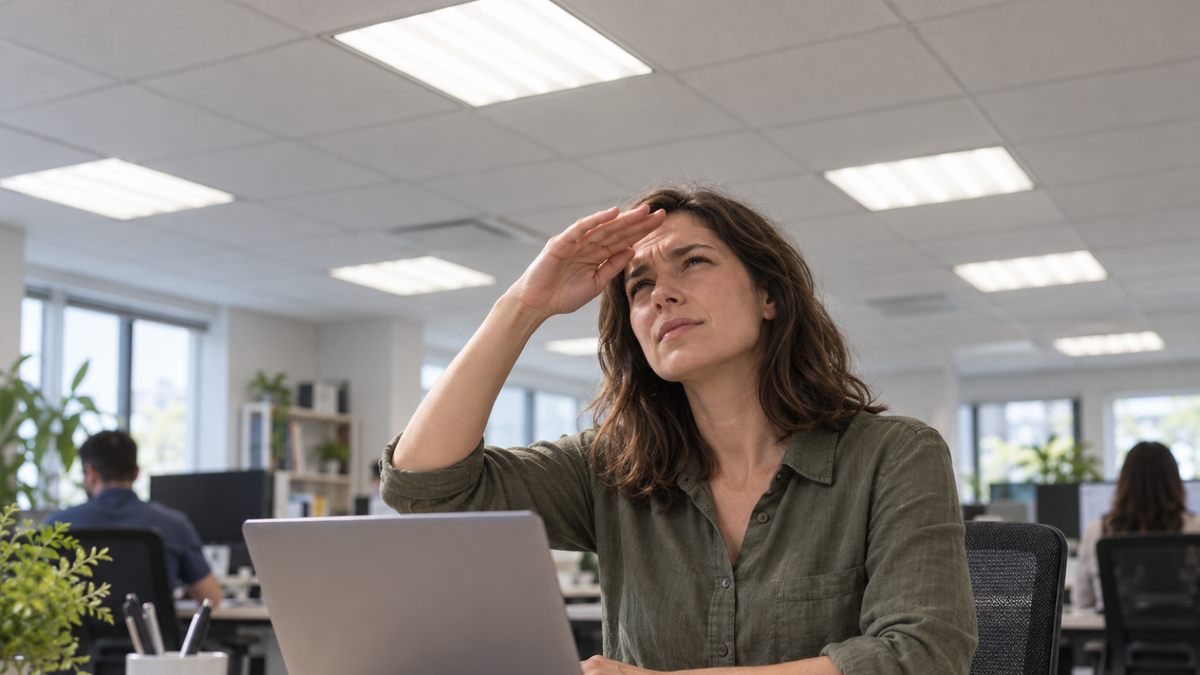
Fluorescent light sensitivity can feel like squinting, eye discomfort, watering, headache, nausea, dizziness, or difficulty focusing under overhead lights. Photophobia is a symptom, not a diagnosis, and fluorescent lighting is only one possible trigger. Start with our light sensitivity overview to understand the broader pattern.
A practical response separates three problems: a health symptom that deserves evaluation, glare or contrast that can be adjusted, and electrical flicker or a failed fixture that needs repair. A passive filter may soften glare from a working fixture, but it does not repair flicker. For compatible troffers, see fluorescent light covers.
The Many Potential Symptoms of Light Sensitivity
Symptoms vary by person and can begin immediately or build through the day. Common reports include:
- Squinting, involuntary blinking, or difficulty keeping the eyes open.
- Watery, dry, red, or irritated eyes.
- Eye discomfort, visual fatigue, blurred vision, or trouble shifting focus.
- Headache or migraine symptoms that worsen around bright light.
- Nausea, dizziness, or a strong need to leave the bright environment.
These symptoms do not prove that fluorescent lighting caused an underlying condition. Note when and where symptoms occur, whether a specific fixture flickers or buzzes, and whether daylight, screens, or reflections produce the same response.
Photophobia is a Potentially Debilitating Symptom of Numerous Health Conditions
Photophobia can accompany migraine, dry eye, eye inflammation or injury, concussion, neurological conditions, and medication effects. A person may also be bothered by ordinary glare without having clinical photophobia. Sudden or severe light sensitivity, eye pain, redness, vision loss, fever, neck stiffness, or symptoms after a head or eye injury require prompt medical evaluation.
Persistent symptoms should be discussed with an optometrist, ophthalmologist, or other qualified clinician. Lighting adjustments can improve an environment, but they do not diagnose or treat the underlying cause.
The Headache-Inducing Signals that Contribute to Light Sensitivity
Migraine research shows that visual discomfort involves more than normal sight. Signals from cones and melanopsin-containing retinal ganglion cells can contribute to light discomfort, and people with migraine may process those signals differently. The exact response varies by wavelength, brightness, contrast, and the individual.
For headache-specific decisions, use the fluorescent light headache guide. It explains environmental options without treating light exposure as the only cause of migraine.
Heightened Sensitivity Caused by Visual Stimuli
Direct glare comes from a bright fixture in the line of sight. Reflected glare comes from light bouncing off a monitor, glossy desk, whiteboard, floor, or window. Large jumps between a bright ceiling and a dim screen also force repeated visual adaptation. These problems can exist even when a room meets its required light level.
Try low-risk changes first: turn a monitor away from reflections, adjust blinds, match screen brightness to the room, use a shaded task light, increase text size, and keep glossy surfaces out of the main viewing angle. Do not tape paper, fabric, or other improvised materials over a fixture.
Even Flicker-Free Lights Transmit Chaotic Signals
The phrase “flicker-free” is not a guarantee that every person will be comfortable, but discomfort does not prove that hidden flicker is the cause. Visible flicker, buzzing, cycling, discoloration, or delayed starting can indicate a failing lamp, ballast, or LED driver. Those problems belong with facilities or a qualified electrician.
A passive cover or filter changes glare and spectral distribution only after the fixture is working correctly. Read how fluorescent flicker differs from glare before choosing a room-level fix.
The Potential Impact of Artificial Light on Sleep Cycles
Light exposure helps set circadian timing, while bright light late in the evening can delay sleep for some people. The useful response is not to label all fluorescent light as harmful. Use brighter daytime light when appropriate, reduce unnecessary brightness near bedtime, and manage screens or task lights that are close to the eyes. Sleep problems that persist need their own medical evaluation.
The Potential Consequences of Indoor Ultraviolet Light
Fluorescent lamps create ultraviolet radiation inside the tube, and the phosphor coating converts most of it into visible light. The amount that reaches a person depends on the lamp, diffuser, distance, and fixture condition. Broad claims that ordinary fluorescent lighting causes eye disease are not supported by this article.
People with lupus, photosensitizing medications, or another diagnosed UV-sensitive condition should follow guidance from their clinician and facility team. NaturaLux fluorescent flat-panel filters block 100% of UVB and up to 98% of UVA under the documented product test conditions.
The Effects of Fluorescent Lights on Productivity and Learning
Glare, poor contrast, visible flicker, and uneven illumination can make reading, screen work, and classroom tasks harder. That supports a comfort and usability case for improving lighting, but it does not prove that one lamp type causes lower productivity or learning outcomes.
For workplace requests, document the fixture, time, task, symptoms, and changes already tried. The workplace accommodations guide explains how to organize that conversation.
Fluorescent Lighting Does Have Distinct Advantages
Fluorescent systems remain common because they can illuminate large areas efficiently and their fixtures may still be serviceable. Replacement is not always the first or best step. Start by fixing failed components, cleaning or replacing damaged diffusers, correcting layout and controls, and confirming that the room still has enough task light.
If a functional fixture remains harsh, a compatible filter can be tested on one fixture or one room before a larger rollout. Keep enough illumination for the task and verify local safety and facility requirements.
The Best Fluorescent Filters Block UV Rays While Transforming the Color Spectrum
NaturaLux fluorescent flat-panel filters are designed for compatible enclosed troffers. They reduce measured glare by 90%, retain about 80% of real-world light output, improve measured color rendering from CRI 88 to 95.3, and block 100% of UVB and up to 98% of UVA. The flat panels carry a Class A fire rating. Tube sleeves are a different product and do not carry that rating.
A filter does not repair electrical flicker, a failed ballast, or an unsuitable fixture. If you are unsure which product fits, use the product guide or request a lighting quote for a multi-room project.
For a broader step-by-step plan that includes personal tools, room changes, and medical limits, read how to reduce light sensitivity. For evidence and tradeoffs around tinted eyewear, see the FL-41 guide.
Can fluorescent lights make light sensitivity worse?
They can aggravate symptoms for some people through glare, contrast, flicker, or brightness, but the reaction does not identify the underlying cause. Compare different rooms and light sources, document the pattern, and seek professional care for persistent or severe symptoms.
Do fluorescent light filters stop flicker?
No. A passive filter may reduce glare and alter the light reaching the room, but a flickering lamp, ballast, or driver needs qualified repair.
When should light sensitivity be checked by a professional?
Seek prompt care for sudden light sensitivity, severe eye pain, redness, vision loss, fever, neck stiffness, or symptoms after a head or eye injury. Persistent symptoms also deserve evaluation.
Sources
American Migraine Foundation: Photophobia and migraine
Canadian Centre for Occupational Health and Safety: Lighting ergonomics
Canadian Centre for Occupational Health and Safety: Light flicker
Proceedings of the National Academy of Sciences: Migraine photophobia and retinal signals
Better light is better health
Browse filters ready to ship, or get a custom quote for your space.