FL-41 Tinted Lenses: Uses, Evidence, and Limitations
FL-41 tinted lenses may help some people with light sensitivity. Review the evidence, limits, workplace options, and when to see an eye-care clinician.

FL-41 tinted lenses are rose or amber optical filters intended to reduce selected parts of visible light before it reaches the eyes. Small studies suggest they may reduce light-related discomfort for some people with chronic ocular pain or benign essential blepharospasm. The evidence is limited, condition-specific, and not a guarantee of benefit. For a broader overview of symptoms and environmental options, see Make Great Light's light sensitivity guide.
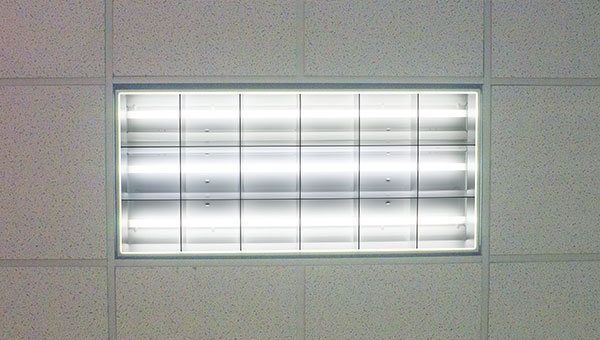
FL-41 eyewear is a personal intervention. A room-level option changes the light from a compatible fixture instead. Make Great Light's passive NaturaLux™ Fluorescent Light Covers may reduce glare and improve light quality while retaining about 80% of light output in real-world use. They do not cure or prevent migraine or photophobia, and they do not replace clinical care.
What are FL-41 tinted lenses?
FL-41 refers to a family of precision tints, usually rose, pink, or amber in appearance. The lenses reduce some wavelengths more than others rather than darkening the whole visible spectrum evenly. This selectivity distinguishes them from neutral gray sunglasses, but it does not make every product sold as FL-41 identical.
Transmission curves vary by material, coating, manufacturer, and tint density. It is therefore inaccurate to assign one fixed wavelength band to every FL-41 lens. In a 2024 study of one FL-41 lens, measured attenuation was broad, approximately 430 to 630 nanometers. That curve describes the study lens, not every formulation.
Tint density also matters. A lighter indoor lens may preserve more overall brightness, while a darker lens may alter brightness and color perception more noticeably. If wavelength performance matters, ask the manufacturer for a measured transmission curve rather than relying on lens color or a product label alone.
What does the research show?
The strongest accurate summary is modest: small studies support benefit for some people and conditions, but the evidence base is limited and does not show that FL-41 works for everyone with migraine, photophobia, eye strain, or light sensitivity.
A 2024 chronic ocular pain case series
A 2024 prospective case series enrolled 25 people with chronic ocular pain, dry-eye symptoms, and photophobia. Participants underwent light stimulation during functional MRI with and without FL-41 lenses. Nineteen reported less light-evoked unpleasantness with the lenses, two reported no change, and four reported more unpleasantness. Group brain-activation patterns also changed while the lenses were worn.
This study is useful because it measured immediate responses under controlled testing, but it was not a randomized trial and had no separate placebo-lens group. It cannot establish how often benefits persist during daily use or predict an individual result.
Randomized studies in benign essential blepharospasm
A 2009 paper reported two randomized crossover studies in benign essential blepharospasm, a movement disorder that causes involuntary blinking or eyelid closure. In one study, 30 participants compared FL-41 with gray lenses. In the second, researchers measured blinking in 26 participants with the condition and 26 controls while they wore FL-41, rose, or gray lenses.
Most participants reported improvement with both FL-41 and gray lenses. FL-41 performed better on several self-reported measures and reduced mean blink rate compared with rose and gray lenses. These findings apply to benign essential blepharospasm. They should not be generalized as proof for everyone with migraine or ordinary workplace discomfort.
A 2006 comparison found no FL-41 advantage over gray
In a 2006 prospective observational comparison, researchers tested light-discomfort thresholds in groups with benign essential blepharospasm, migraine, and no diagnosed light sensitivity. Both gray and FL-41 lenses improved thresholds in all groups, but the study found no difference between the two tints.
That result is an important limitation. It suggests that reducing overall brightness may account for some benefit in a controlled test, and that FL-41 is not consistently superior to a neutral tint across every measure.
The 2016 migraine notch-filter trial was not an FL-41 trial
A frequently cited 2016 randomized crossover trial studied two thin-film optical notch filters centered at different wavelengths in people with chronic migraine. Thirty-seven of 48 participants completed the trial. Headache-impact scores improved while either filter was worn, but the overall difference between the filters was not significant.
Those lenses were engineered notch filters, not FL-41 lenses. The trial can inform a broader discussion of spectral filtering, but it should not be presented as direct evidence for FL-41 in migraine.
| Study | Population and design | Main result | What it cannot establish |
|---|---|---|---|
| 2024 FL-41 case series | 25 people with chronic ocular pain and photophobia | 19 reported less unpleasantness, 2 no change, 4 more | Effectiveness for all causes of photophobia or long-term daily use |
| 2009 FL-41 crossover studies | People with benign essential blepharospasm, plus controls in one study | FL-41 improved several measures and reduced mean blink rate | General migraine prevention or universal benefit |
| 2006 tint comparison | Blepharospasm, migraine, and control groups | Gray and FL-41 both improved thresholds with no difference between them | Superiority of FL-41 over neutral tint |
| 2016 notch-filter trial | 37 completers with chronic migraine | Both filters improved scores; no significant difference between filters | Direct evidence about FL-41 |
Uses and limitations in everyday settings
Someone with diagnosed photophobia, chronic ocular pain, or benign essential blepharospasm may discuss precision tinting with an eye-care clinician. A clinician can also check whether glare, an outdated prescription, dry eye, inflammation, cataract, or another issue is contributing to symptoms.
FL-41 may be portable across settings, but a tint can affect brightness and color appearance. That tradeoff matters for driving, stairs, low-light work, visual inspection, photography, design, and any task where color judgment or hazard detection is important. Lens response is individual, so a short trial and a clear return policy may be useful when available.
FL-41 is also not synonymous with a generic screen filter. The evidence and practical options differ by device and task. This guide to blue-light screen filters and workplace lighting separates screen settings, glare control, and room lighting without assuming blue light is the only cause of discomfort.
Personal lenses versus room-level light changes
Personal and environmental approaches solve different parts of a lighting problem. Neither should be framed as universally better. Start by identifying whether the main issue is light entering one person's eyes, reflected glare, excessive contrast, an incompatible fixture, or an electrical fault.
| Consideration | FL-41 or another personal tint | Room-level light-quality changes |
|---|---|---|
| Who is affected | One wearer | People using the adjusted area may experience the change differently |
| Portability | Moves with the wearer | Stays with the room or fixture |
| Color and brightness | Can alter the wearer's color and brightness perception | Changes the room's delivered light and must preserve enough task light |
| Best fit | Individual trial guided by symptoms and tasks | A working fixture that remains harsh or creates direct glare |
| Important limit | Does not change the source for anyone else | Does not diagnose symptoms or replace individual care |
| Maintenance boundary | Cannot repair the fixture | Passive filters cannot repair electrical flicker, ballasts, drivers, or failed fixtures |
For compatible working fixtures, NaturaLux LED Light Covers and fluorescent filters are passive optical products. They may reduce glare by up to 90% and improve light quality, but they do not repair electrical flicker, failing ballasts or drivers, or failed fixtures. Buzzing, visible flicker, intermittent operation, heat, damage, or discoloration should be evaluated through qualified facilities maintenance.
Facility teams can use the office lighting guide to separate glare, reflections, light distribution, and maintenance issues before choosing a product.
Practical workplace adjustments
Begin with reversible changes that match the source of discomfort. Reposition and tilt a monitor so ceiling fixtures or windows are not reflected in the screen. Use blinds or shades to control direct window glare. Match screen brightness to the surrounding room, and add a task light when the desk is dim but the ceiling is bright.

If a functional fixture remains harsh, test a compatible diffuser or filter in one area before making a broader change. Confirm that the resulting space still provides enough light for the work. If the concern affects one employee, an individualized conversation may be more appropriate than changing an entire floor.
The workplace accommodations guide for light sensitivity explains how an employee can document the functional problem and discuss possible adjustments without assuming one accommodation fits every role.
When to consult an eye-care clinician
Persistent light sensitivity deserves an eye-care evaluation, especially when it is new, worsening, or interfering with normal activities. Seek prompt clinical advice for one-sided symptoms, sudden onset, eye pain, redness, vision loss, new flashes or floaters, double vision, or symptoms after an injury. This article provides general education and is not medical advice.
Bring notes about when symptoms occur, which light sources are involved, whether one eye differs from the other, and how long the response lasts. That information can help a clinician assess possible causes and decide whether a tint trial, prescription update, ocular-surface care, or another response is appropriate.
Frequently asked questions about FL-41 lenses
What are FL-41 tinted lenses?
FL-41 lenses are rose or amber optical tints designed to reduce selected parts of visible light. The exact color, darkness, and transmission curve vary by manufacturer, so FL-41 is not one universal spectral specification.
Do FL-41 glasses work for migraine or photophobia?
Small studies support benefit for some people and specific conditions, but the evidence is limited and results are not universal. The cited migraine trial tested different notch filters, not FL-41 itself.
Can you wear FL-41 lenses all day?
Wear time depends on the tint, the task, and individual response. Because tinted lenses can change brightness and color appearance, ask an eye-care clinician about a suitable lens and schedule, especially for driving or color-critical work.
Are FL-41 lenses the same as blue-light glasses?
No. Both labels cover products with different transmission curves, and ordinary blue-light glasses are not automatically FL-41. Ask the seller for a measured transmission curve if spectral performance matters to your decision.
Do room-level light filters replace FL-41 lenses?
No. Personal lenses filter light reaching one wearer, while room-level filters change light from compatible fixtures. Either, both, or neither may fit a situation, and passive fixture filters do not repair flicker or failed electrical components.
Stop the headaches at the source
Browse filters ready to ship, or get a custom quote for your space.