Light at Night and Heart Health: What the 3-Lux Study Found
A study linked light at night with small heart changes. Learn what 3 lux means, what the findings cannot tell us, and simple steps for day and night.

New research on light at night and heart health found a link between more light during nightly rest and small differences in heart scans. It also found higher rates of some heart and blood-vessel problems. The 2026 study watched patterns in people's lives. It did not prove that light caused these outcomes. Study source
This article is for general educational purposes and is not medical advice.
What the 2026 study found
The study used UK Biobank, a large health research project. A group of 11,071 adults wore wrist sensors for seven days. The sensors tracked light during their rest periods. About three years later, the adults had heart scans. Their average age was 61. None had heart or blood-vessel disease at the start.
Researchers compared high exposure with no exposure to light above 3 lux during rest. Lux measures how much visible light reaches a surface.
The high-exposure group had small differences in heart structure and function. Researchers call this “cardiac remodeling,” meaning changes in the heart's shape or how it works. These findings do not mean every exposed person developed heart disease.
One measure of heart muscle mass was 2.4% higher. The study's uncertainty range was 1.6% to 3.1%. Average wall thickness was 1.5% higher, with a range of 1.0% to 2.0%. These ranges are called 95% confidence intervals. They show how precise the estimates are. Heart-scan findings
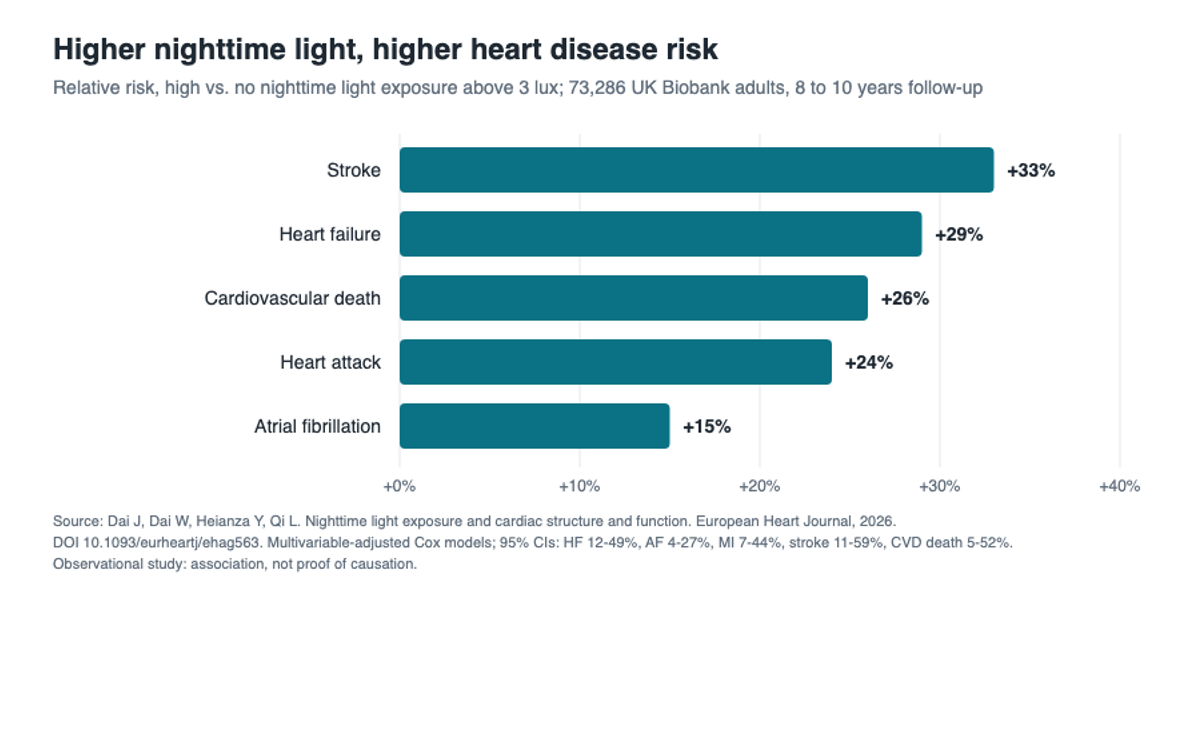
The scan group was part of a larger group of 73,286 people. Researchers tracked heart and blood-vessel outcomes in that larger group for about 8 to 10 years. Higher nighttime light exposure was linked with higher rates of stroke, heart failure, heart attack, irregular heartbeat, and death from heart and blood-vessel disease.
For stroke, high exposure was linked with a 33% higher relative risk than no exposure above 3 lux. The uncertainty range was 11% to 59%. This compares groups. It does not mean your own chance of stroke rises by 33 percentage points. The study summary lacks the event counts needed to calculate absolute risk: how many people out of a group had a stroke. Outcome findings
Is 3 lux very bright?
Three lux can seem dim in a room. Yet it is roughly 10 to 30 times brighter than typical full moonlight, about 0.1 to 0.3 lux. Those values are approximate. A hall light, streetlight, or screen can add bedroom light. Distance, angle, light color, eyelids, and whether light reaches the eye all affect exposure.
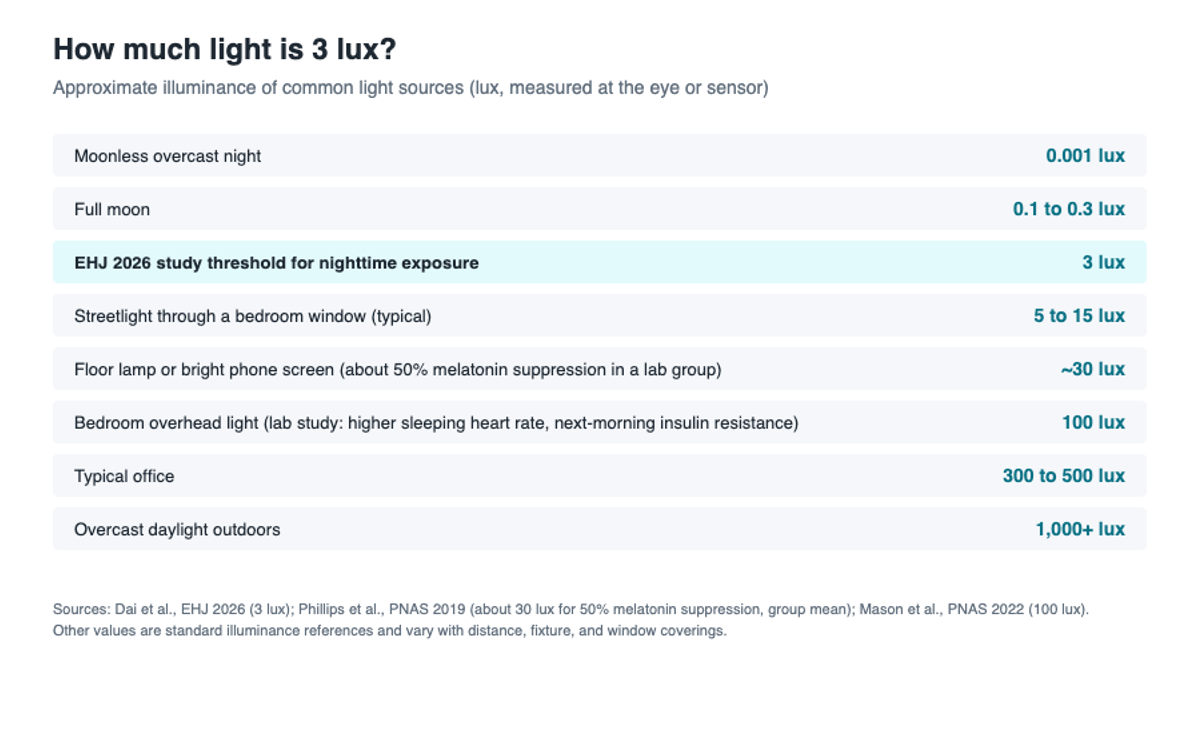
Three lux was a study measure. It is not a medical cutoff that divides safe light from unsafe light.
Why the findings matter
The findings give researchers another reason to study light timing. The links remained after accounting for factors such as age, smoking, activity, and blood pressure. More exposure was linked with larger differences. Study findings
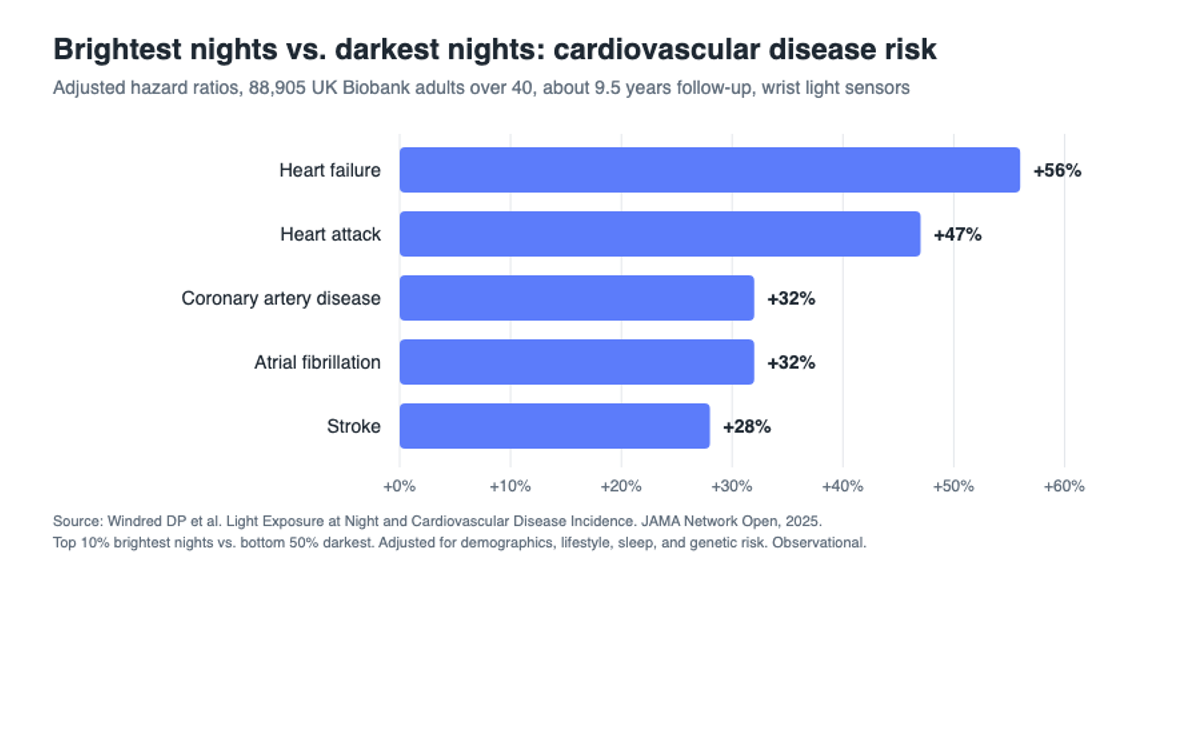
A 2025 study also linked brighter nights with higher rates of several heart conditions. Brighter days were linked with lower rates of heart failure and stroke. Both studies were observational: researchers watched people rather than assigning their light exposure. Neither proves cause and effect. 2025 study
People exposed to more light at night may differ in other ways that affect health. Housing, work hours, sleep habits, and city life could help explain the findings. Adjusting for known factors cannot rule out every other cause.
The new study also has limits. One week of readings may miss long-term habits. A wrist sensor measures light at the wrist, not at the eyes. It did not record light color. The adults were older and almost all White, so the findings may not apply equally to everyone.
The heart-scan differences were small. Their long-term meaning for one person's health is unclear. No randomized trial has yet shown that darkening a bedroom reverses these changes or prevents heart attacks or strokes. A randomized trial assigns people to different conditions to test an effect.
Simple ways to manage light day and night
This article is for general educational purposes and is not medical advice.
If you have heart disease, an irregular heartbeat, a sleep disorder, a night-shift schedule, or a risk of falls, discuss changes with a qualified clinician.
Daytime: Get enough comfortable light
Seek outdoor daylight when practical. Indoors, use enough light to read, work, and move safely.
Make Great Light's NaturaLux™ filters soften harsh glare from daytime fluorescent and LED fixtures while retaining about 80% of real-world light output. They can improve visual comfort. They do not make a dim room brighter.
These passive filters do not repair electrical flicker or failed fixtures. They do not dim lights on a schedule or set a medical light dose. They have not been studied for heart outcomes. They do not prevent or treat disease, improve melatonin, fix circadian rhythm, or darken bedrooms. Melatonin is a hormone tied to sleep timing. Circadian rhythm means the body's daily clock. For a plain explanation of why that body clock matters, read why circadian rhythm is important.
For daytime glare, explore LED light filters or office lighting options. For more ways to reduce daytime glare from overhead lights, read these office glare tips.
Evening: Lower the light before bed
In the three hours before bed, dim lights where practical. Choose warm-colored light. Place it below eye level when safe. Lower screen brightness and turn off bright overhead lights you do not need.
Sleep: Reduce light while keeping safe
Close curtains or shades to block streetlight spill. Cover or remove unneeded device lights. Keep screens off during sleep when possible.
Keep enough light to walk safely if you get up. Darkness should never create a fall hazard. Caregiving, anxiety, work, and safety needs can shape what is possible. Start with a change that fits your life.
What about expert light targets?
A 2022 expert panel proposed targets for healthy adults: at least 250 melanopic EDI lux by day, no more than 10 in the three hours before bed, and no more than 1 during sleep. “Melanopic EDI” measures light's effect on eye cells that help set the body clock. These targets are measured at the eye.
They differ from ordinary lux and the study's 3-lux measure. Do not swap them or treat them as heart-disease thresholds. Product performance has not been measured against these targets. Expert guidance
Five short FAQs
Can sleeping with lights on cause heart disease?
These studies found links. They did not prove that light caused disease. Other parts of people's lives may help explain the results.
Is 3 lux the same as moonlight?
No. It is roughly 10 to 30 times brighter than typical full moonlight. Actual readings vary with conditions and sensor placement.
How dark should a bedroom be?
Reduce unneeded light while keeping the room safe. The expert sleep target uses melanopic EDI at the eye, a different measure from ordinary lux.
Are bright lights bad during the day?
Daytime light helps with daily tasks. Seek enough comfortable light, then lower the light before bed. The nighttime findings do not justify avoiding daytime light.
Can light filters prevent heart disease?
No. They have not been shown to prevent, treat, or reduce heart disease. Their role here is daytime lighting comfort.
Sources
- Dai et al. European Heart Journal, September 10, 2026. Nighttime light, heart scans, and heart outcomes. DOI: 10.1093/eurheartj/ehag563.
- Windred et al. “Light Exposure at Night and Cardiovascular Disease Incidence.” JAMA Network Open, October 23, 2025. DOI: 10.1001/jamanetworkopen.2025.39031.
- Brown et al. “Recommendations for daytime, evening, and nighttime indoor light exposure to best support physiology, sleep, and wakefulness in healthy adults.” PLOS Biology, March 17, 2022. DOI: 10.1371/journal.pbio.3001571.